
PREMIUM LOGIN
ClassTools Premium membership gives access to all templates, no advertisements, personal branding and many other benefits!
| Username: | ||
| Password: | ||
|
Submit
Cancel
|
||
| Not a member? | ||
PREMIUM LOGIN
ClassTools Premium membership gives access to all templates, no advertisements, personal branding and many other benefits!
| Username: | ||
| Password: | ||
|
Submit
Cancel
|
||
| Not a member? | ||
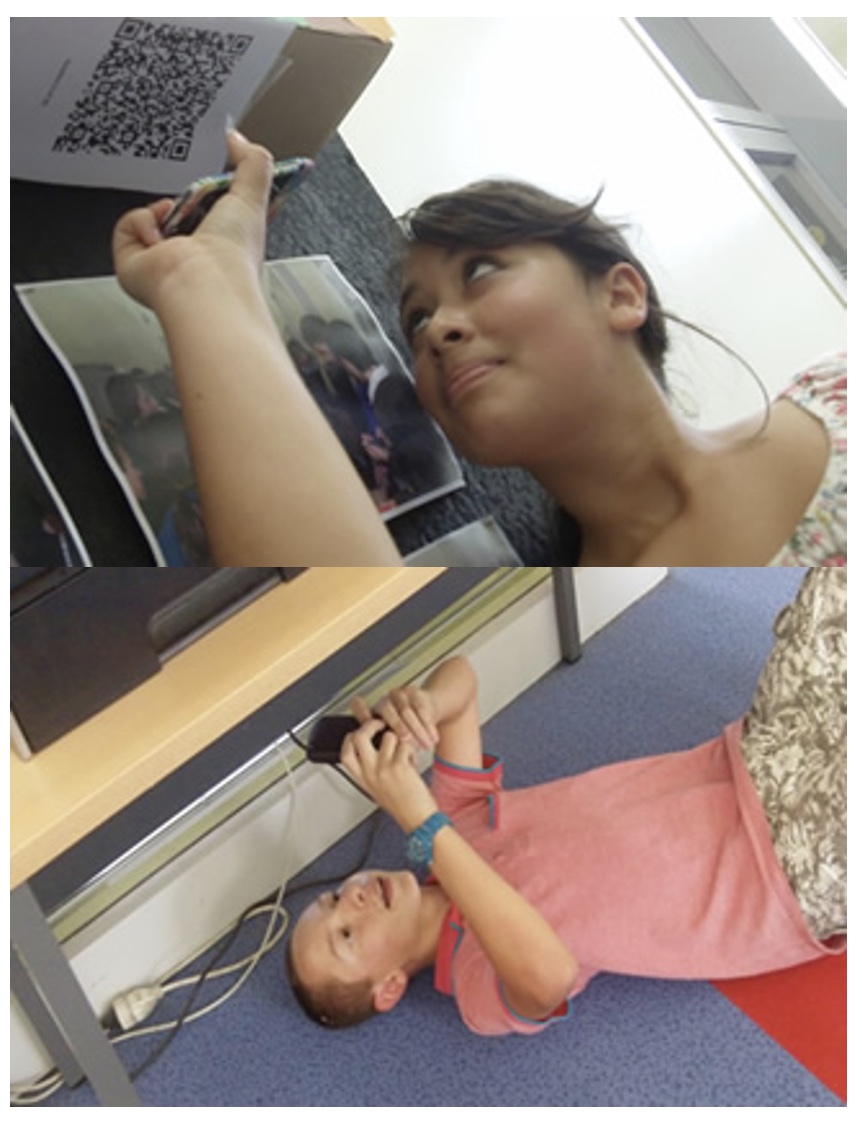
1. Arrange students into groups. Each group needs at least ONE person who has a mobile device.
2. If their phone camera doesn't automatically detect and decode QR codes, ask students to
4. Cut them out and place them around your class / school.
1. Give each group a clipboard and a piece of paper so they can write down the decoded questions and their answers to them.
2. Explain to the students that the codes are hidden around the school. Each team will get ONE point for each question they correctly decode and copy down onto their sheet, and a further TWO points if they can then provide the correct answer and write this down underneath the question.
3. Away they go! The winner is the first team to return with the most correct answers in the time available. This could be within a lesson, or during a lunchbreak, or even over several days!
4. A detailed case study in how to set up a successful QR Scavenger Hunt using this tool can be found here.
Question | Answer |
| 1. What is the main difference between prokaryotic and eukaryotic cells? | The main difference is that prokaryotic cells lack a true nucleus and membrane-bound organelles, whereas eukaryotic cells have a true nucleus and membrane-bound organelles. | 2. Which organelle is responsible for producing ATP, the cell's primary energy currency? | The mitochondria are responsible for producing ATP through cellular respiration. They are often referred to as the "powerhouse of the cell." | 3. What is the function of the Golgi apparatus in a eukaryotic cell? | The Golgi apparatus processes, modifies, and packages proteins and lipids for transport within the cell or for secretion outside the cell. | 4. What is the role of the endoplasmic reticulum in a eukaryotic cell? | The endoplasmic reticulum (ER) plays a role in protein synthesis and lipid metabolism. Rough ER is studded with ribosomes and is involved in protein synthesis, while smooth ER is involved in lipid synthesis and detoxification. | 5. What is the primary function of the cell membrane in a cell? | regulates the passage of substances in and out of the cell. | 6. In which type of cell, prokaryotic or eukaryotic, can you find membrane-bound organelles like the endoplasmic reticulum and mitochondria? | Membrane-bound organelles like the endoplasmic reticulum and mitochondria are found in eukaryotic cells. | 7. Which organelles are only in plants? | Chloroplast, cellulose, large vacuole | 8. Which organelle is responsible for the cellular digestion? | lysosome | 9. Why linear magnification is necessary? | Linear magnification is necessary to make small or distant objects and details more visible, aiding in fields such as microscopy, quality control, research, medicine, engineering, education, astronomy, and more. It helps us examine and understand the world at different scales. | 10. How many meters is one nanometer equal to? | 0.000000001 meters, or 1 x 10^-9 meters | 11. Write the biological classification in order | species, genus, family, order, class, phylum, kingdom | 12. Why predators are important for an ecosystem? | Predators are important for an ecosystem because they help regulate prey populations, maintain ecological balance, and promote species diversity. | 13. Greenhouse gases | CO2, No, CH4, O3 | 14. What is duodenum? | first part of a small intestine | 15. function of large intestine | absorption of water |

Question 1 (of 15)
Question 2 (of 15)
Question 3 (of 15)
Question 4 (of 15)
Question 5 (of 15)
Question 6 (of 15)
Question 7 (of 15)
Question 8 (of 15)
Question 9 (of 15)
Question 10 (of 15)
Question 11 (of 15)
Question 12 (of 15)
Question 13 (of 15)
Question 14 (of 15)
Question 15 (of 15)