
PREMIUM LOGIN
ClassTools Premium membership gives access to all templates, no advertisements, personal branding and many other benefits!
| Username: | ||
| Password: | ||
|
Submit
Cancel
|
||
| Not a member? | ||
PREMIUM LOGIN
ClassTools Premium membership gives access to all templates, no advertisements, personal branding and many other benefits!
| Username: | ||
| Password: | ||
|
Submit
Cancel
|
||
| Not a member? | ||
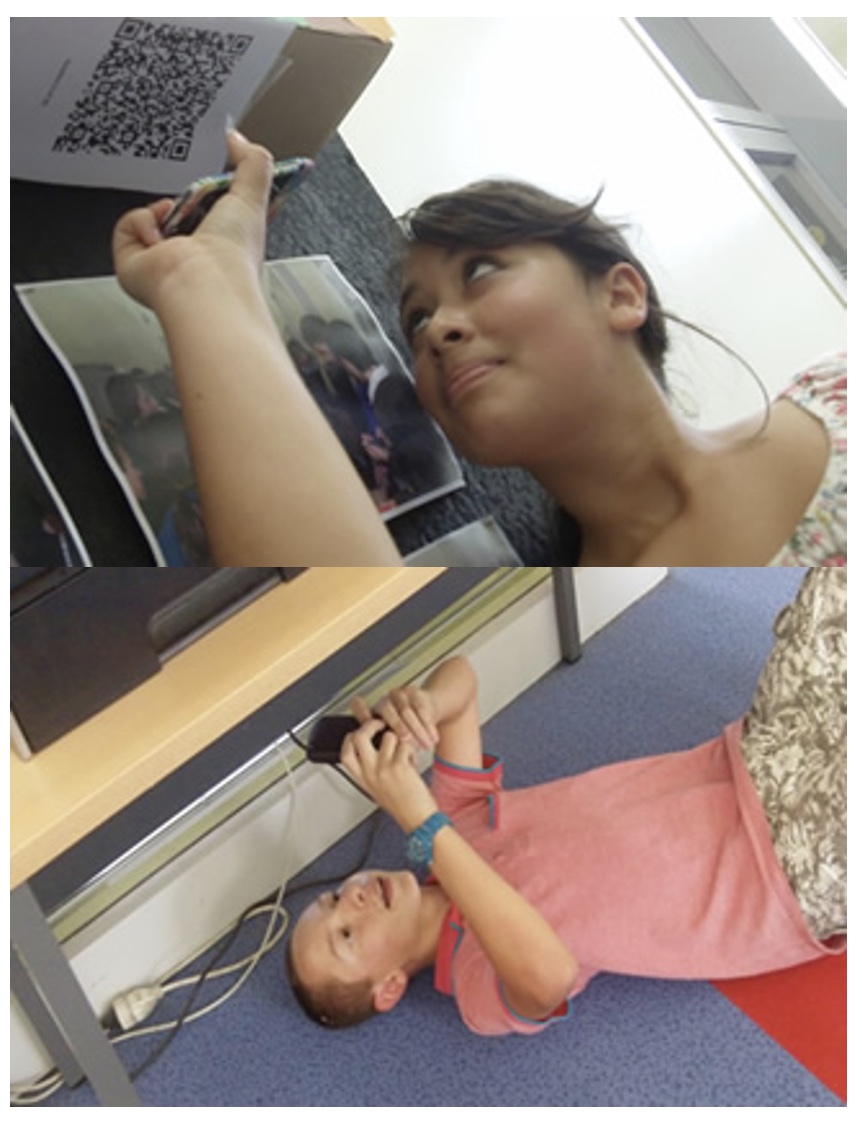
1. Arrange students into groups. Each group needs at least ONE person who has a mobile device.
2. If their phone camera doesn't automatically detect and decode QR codes, ask students to
4. Cut them out and place them around your class / school.
1. Give each group a clipboard and a piece of paper so they can write down the decoded questions and their answers to them.
2. Explain to the students that the codes are hidden around the school. Each team will get ONE point for each question they correctly decode and copy down onto their sheet, and a further TWO points if they can then provide the correct answer and write this down underneath the question.
3. Away they go! The winner is the first team to return with the most correct answers in the time available. This could be within a lesson, or during a lunchbreak, or even over several days!
4. A detailed case study in how to set up a successful QR Scavenger Hunt using this tool can be found here.
Question | Answer |
| 1. Question1 | How many different types of mixtures are there? | 2. Answer1 | two different types homogeneous and heterogeneous. | 3. Question2 | What is the difference between homogeneous and heterogeneous mixtures? | 4. Answer2 | Homogeneous mixtures are mixed evenly and can be separated by evaporation. Heterogeneous mixtures can be easily separated and maintain all there physical properties. | 5. Question3 | Can a solution be classified as a mixture? If so Why? | 6. Answer3 | It can be classified as a mixture because you can separate the different components through the process of evaporation. | 7. Question4 | How can you separate a mixture? | 8. Answer4 | You can separate a mixture with a magnet, filter, by hand, or evaporation. | 9. Question5 | What is a solute used in making lemonade? | 10. Answer5 | The solute is the sugar . It dissolves in the lemon solution. | 11. Question6 | What is a solvent? | 12. Answer6 | The solvent is the substance in which the solute is being dissolved in. | 13. Question7 | What is a sieve ? | 14. Answer7 | A sieve is an object made of wire or metal used to separate mixtures. | 15. Question8 | What is a solute? | 16. Answer8 | A solute is the substance that is being dissolved in a solution. | 17. Question9 | How can you separate sand and iron filings? | 18. Answer9 | A mixture of sand and iron filings can be separated with a magnet. | 19. Question 10 | When a solution reaches the boiling point, what happens to the solvent and solute? | 20. Answer10 | The solute that was dissolved starts to reappear and the solvent starts evaporating. | 21. Question11 | . What is an item that is soluble and one item that is not soluble? | 22. Answer11 | Sand is not soluble and salt is soluble. | 23. Question12 | By looking at the items on the table, classify them as a mixture or solution. ( lemonade, oil and water, sand and water, Chex mix, Trail mix, cereal , milk, Gatorade). | 24. Answer12 | The solutions are lemonade, Gatorade, and milk. The mixtures are oil and water, sand and water, chex mix, trail mix, and cereal. | 25. Question13 | Create a mixture using the items below. Explain why it is a mixture. | 26. Answer13 | We create a mixture of erasers, paperclips, staples, rubber bands and straws. This is a mixture because all the components maintain their physical properties. | 27. Question14 | I am a mixture or solution. I am made up of water and crystal light powder. What am I and why? | 28. Answer14 | You are a solution because the crystal light powder is a solute being dissolved in the solvent of water. | 29. Question15 | In your group create 3 mixtures and 3 solutions. Then give each student clues on what is in your mixture or solution. Have them classify the mixtures based off of the clues you give them. Use QR Codes for each clue. | 30. Answer15 | Answers may vary. |

Question 1 (of 30)
Question 2 (of 30)
Question 3 (of 30)
Question 4 (of 30)
Question 5 (of 30)
Question 6 (of 30)
Question 7 (of 30)
Question 8 (of 30)
Question 9 (of 30)
Question 10 (of 30)
Question 11 (of 30)
Question 12 (of 30)
Question 13 (of 30)
Question 14 (of 30)
Question 15 (of 30)
Question 16 (of 30)
Question 17 (of 30)
Question 18 (of 30)
Question 19 (of 30)
Question 20 (of 30)
Question 21 (of 30)
Question 22 (of 30)
Question 23 (of 30)
Question 24 (of 30)
Question 25 (of 30)
Question 26 (of 30)
Question 27 (of 30)
Question 28 (of 30)
Question 29 (of 30)
Question 30 (of 30)